Start at full price, discount deliberately, and re-raise on evidence — that is how to price an e-book for its first 90 days. The anchor fact: Amazon's 70 percent royalty band covers $2.99 to $9.99, per KDP's help pages, so most indie fiction launches cluster inside it, and the sequence below works within that band.
One honest caveat before the numbers: pricing experiments produce wildly different outcomes by genre, audience, and luck. These are defensible defaults, not promises. Results vary, and ninety days of your own sales data will always outrank any guide, including this one.
What should the launch price actually be?
Your best guess at the book's long-term list price, not a bargain-bin apology. For indie novels that usually means $3.99 to $5.99; longer epic fiction carries more; short nonfiction can carry less, per the Alliance of Independent Authors' pricing guidance. Launching at your real price establishes the anchor every later discount hangs from.
Authors underprice debuts out of fear, and the discount logic punishes them for it. If you launch at $0.99, your first promotion has nowhere to go — free — and readers who paid full price for a $5.99 skill level will never know it. A launch at $4.99 followed by a visible $1.99 promo reads as a deal; a permanent $0.99 sticker reads as a pamphlet. Genre norms matter here: romance readers see $4.99 as normal, while epic fantasy readers accept $6.99 for a 700-page tome. Look at the top twenty indie titles in your category in the month before launch and park near the median. Then stop refreshing the charts and write the next book.
When should the first discount happen, and how deep?
Between day 30 and day 60, once the launch spike has flattened, and deep enough to matter: to $0.99 for a first-in-series, or to $1.99–$2.99 for a standalone. Make it a short, loud event — three to seven days — not a quiet permanent markdown that trains readers to wait.
The mechanics favor event pricing. Newsletter promotion services such as BookBub Featured Deals and the smaller genre-specific listmakers require a visible price cut and a scheduled window before they will feature a title, per their submission guidelines. A discount with an end date creates urgency; a permanent price cut creates a ceiling you will spend months escaping. Pair the drop with two or three newsletter placements if your budget allows, then return to list price on schedule. If you are in KDP Select, Countdown Deals handle the limited window natively; if you are wide, you simply change the price in each dashboard and change it back.
What signals say it is time to raise the price?
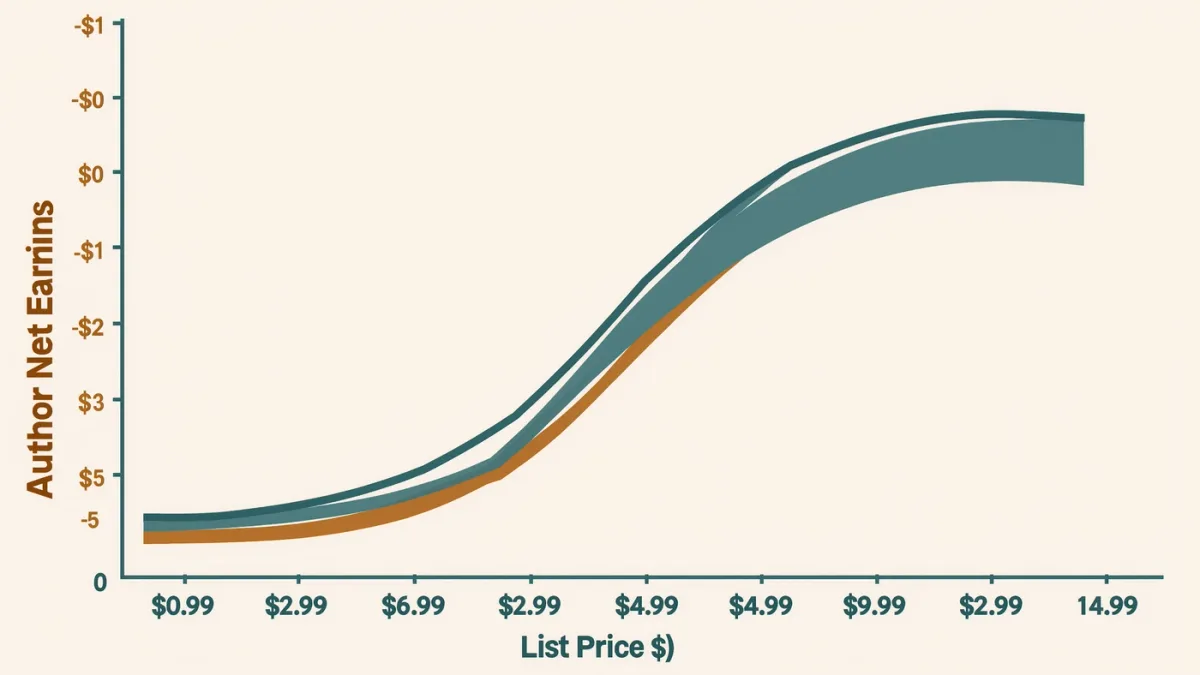
Two signals, both from your own dashboard: unit sales hold steady for ten to fourteen days after the launch noise fades, and sell-through to your other books is visible. When both are true, raise in $0.50 steps and watch a fortnight per step. If units hold, the extra margin was waiting for you.
Price elasticity is real but slower than authors fear. Moving $4.99 to $5.49 rarely dents conversion; doubling $2.99 to $5.99 sometimes does. The mistake is raising and judging after two days — launch-window noise drowns out the signal. Give each step two full weeks, compare units and total revenue, not units alone, and remember that a series earns on book two and three: the first book's job is to open the door, not to collect the full toll at once. If sell-through is strong, keeping book one at $3.99 forever can be the correct greed.
How does price psychology work between $2.99 and $9.99?
Readers read prices as genre shorthand. Inside the band, $X.99 endings outperform round numbers, a dollar difference barely registers at checkout, and free is not a price at all — it is a request for a reader's time, judged accordingly. The floor and the ceiling each carry meaning you should spend deliberately.
| Price point | Reader expectation | Best used for |
|---|---|---|
| $0.99 | Teaser, older title, or promo | Limited drops, first-in-series funnels |
| $2.99–$3.99 | Standard indie novel | Debuts, book one of a series |
| $4.99–$6.99 | Established author, longer book | Later series books, epic fiction |
| $7.99+ | Big name or big page count | Backlist at scale, box sets |
None of these lines is a law. They are expectations, and expectations are what make anchoring work: a crossed-out $5.99 above a $1.99 promo price is a story readers instantly understand. And if you want evidence that book buying itself has seasons, the U.S. Census Bureau's monthly retail data shows bookstore sales peaking each December — worth knowing before you schedule a quiet March promotion and wonder what went wrong.
What does a sane 90-day pricing calendar look like?
Four moves, spread deliberately: full price at launch, one promoted discount, one clean re-raise, and one honest review. Compressed, it looks like this:
- Days 1–14: launch at full list price; focus energy on reviews and visibility, not markdowns.
- Days 15–29: hold price; watch daily units to find your post-launch baseline.
- Days 30–45: run one 3–7 day discount, stacked with newsletter placements if budget allows.
- Days 46–60: return to list price; compare baseline before and after the promo.
- Days 61–90: test one $0.50 raise on steady sellers, or one $1 cut on stalled ones; review everything at day 90.
Then stop experimenting and start writing. The fastest pricing fix for a slow book is a faster sequel.
Frequently asked questions about launch pricing
Is $0.99 ever the right launch price?
Yes, in two cases: a first-in-series you intend as a permanent funnel, and short fiction or novellas where the word count is honest about the price. For a standalone debut, $0.99 anchors the book low and leaves your first promotion nowhere dramatic to go.
How often can I change my e-book's price?
As often as you like — price is never locked. Changes propagate through each store's systems within hours to a couple of days, and nothing about your listing or reviews resets. The constraint is psychological, not technical: constant flapping looks erratic to the readers who watch charts.
Do I need to match my price across stores?
Not strictly, but near-parity saves headaches. Per KDP's pricing pages, Amazon may match a lower price it finds at another retailer — which can turn an intentional single-store promo into an accidental everywhere promo. Coordinate your discount windows across dashboards.
Should book one in a series be cheaper than the rest?
Usually, yes. Series economics live in sell-through: a cheaper or discounted entry point buys readers, and books two through five earn at full price. Keep the ladder logical — say $3.99, then $4.99 and up — so each step up feels earned by the reading habit, not greedy.